For decades, the economic relationship between Australia and New Zealand has been popularly described as a seesaw. The theory goes: when one economy rises, the other dips, driven by the unique treaty that allows free movement of labor across the ditch.
Kiwis love to joke that migrating “raises the IQ of both countries,” but historically, New Zealand has lamented this as a one-way brain drain, losing a net average of 30,000 citizens a year.
However, looking at the dramatic post-COVID era and the shifts we are seeing in early 2026, it’s clear the “seesaw” analogy is too simple. We aren’t just bouncing up and down on opposite ends of a plank; we are caught in a powerful economic undercurrent, and the tide is starting to turn.
The Inflation Web and Diverging Paths
To understand the current shift, we have to look at how both countries handled the pandemic hangover. While massive Quantitative Easing (QE) injected cash into the system, it wasn’t the only villain behind the inflation we’re fighting today. A perfect storm of broken global supply chains, massive fiscal stimulus, and global energy shocks lit the inflationary fire.
Faced with this, our central banks took radically different paths:
The RBNZ’s “Shock and Awe”: New Zealand went hard and early. Governor Adrian Orr prioritised crushing inflation, even if it meant forcing a recession. It cooled the economy, but triggered a massive exodus. At its peak, New Zealand lost over 75,000 citizens to Australia in a 12-month window.
The RBA’s “Soft Landing”: Australia chose to protect employment, accepting a slower decline in inflation. The Australian economy kept growing, fueled in large part by the “human stimulus package” of incoming Kiwi labor.
Rather than just a “brain drain,” this migration acted as a pressure valve for New Zealand during a tough recession, while plugging critical labor gaps in Australia.
The March 2026 Pivot: Has Australia Hit the Squeeze?
Fast forward to March 2026, and the dynamics are flipping.
On March 17, the RBA signaled a harsh reality check. In a tight 5-to-4 vote, they hiked the cash rate by 0.25% to 4.10%. Governor Michele Bullock made it clear: the priority is now inflation, and they are willing to risk a recession to beat it. She also warned the government that broad fuel subsidies would only add fuel to the inflationary fire.
Meanwhile, the RBNZ is signaling stability. Viewing the current oil price shocks as temporary, they are expected to hold the OCR steady on April 8. To help the “squeezed middle” weather the energy costs without spiking inflation, the NZ government opted for a highly targeted $50 weekly payment for lower-income working families.
The Migration Tide Turns: Brain Drain to Brain Gain
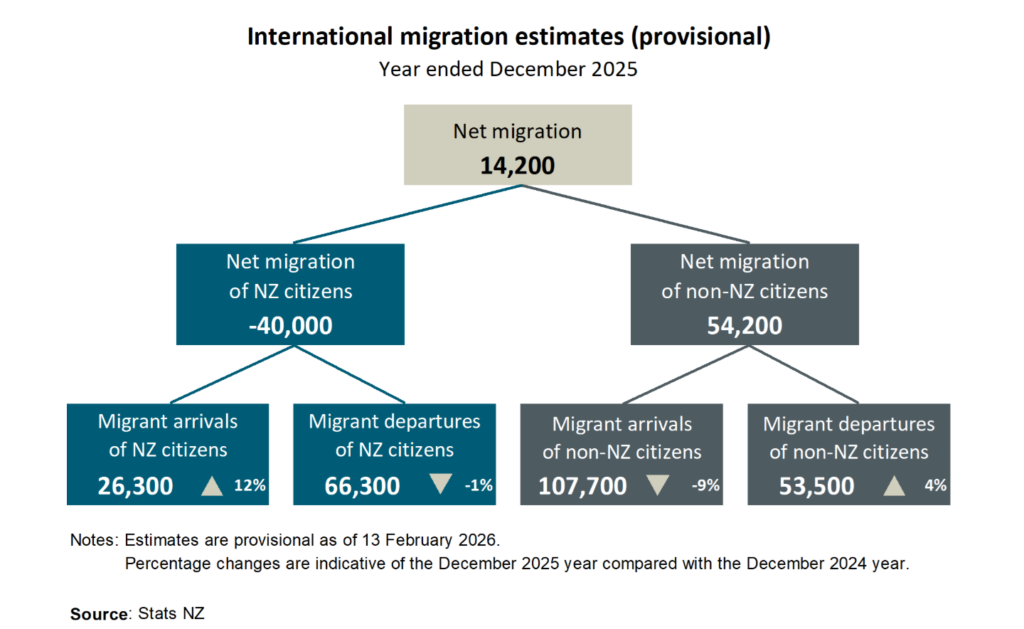
The data proves the undercurrent is shifting back toward Aotearoa. Provisional Stats NZ data for the year ending December 2025 shows the bleeding is slowing:
Net Loss is Shrinking: The net loss of NZ citizens dropped to 40,000, stepping back from the crisis peaks of early 2024.
The Great Return: While 66,300 Kiwis departed, 26,300 returned home.
The Australia Stepping Stone: Interestingly, 61% of citizen departures went to Australia, but 35% of those were actually born outside of NZ, showing the treaty is often used as a stepping stone for newer migrants.
When Kiwis return, it’s not just numbers on a page; it’s a “brain gain.” They bring back global experience, capital, and immediate demand for housing, laying the groundwork for GDP recovery.
The Market Reality: Proceed with Caution
Since late last year, a contrarian strategy has been gaining traction: sell Australian assets at their peak and reinvest in a recovering New Zealand. The currency markets seem to agree. Following the RBA’s recent hike, the NZD actually strengthened against the AUD. Investors are betting that New Zealand has already taken its bitter economic medicine, while Australia is just swallowing the first pill.
However, a critical investor knows that markets are noisy and central banks are reactive. There is no guaranteed perfect recession in Australia, nor a flawlessly smooth recovery in New Zealand. Both nations are still small boats navigating the same volatile global ocean.
But if you are watching the undercurrents, the momentum is undeniably shifting. The Trans-Tasman tide is flowing back to New Zealand.